Getting 20 people to San Francisco International Airport from Oakland seems manageable — until you look at it from the curb. The Bay Bridge is one of the Bay Area's most punishing stretches at 7:30 a.m., and that's just the entry point. From there, it's US-101 South, I-380 West, and then the right departures terminal — Level 2 for domestic, Level 3 for the International Terminal, where the bulk of Bay Area international flights originate.
If your group is split across airlines, split across terminals, or flying United in 2026 (where check-in has moved mid-construction), the individual-car approach starts multiplying into a coordination problem fast. One Oakland charter bus solves the whole sequence: one pickup address, one bridge toll, one confirmed drop-off at the right departures curb. The rest takes care of itself.
SFO handles the overwhelming majority of Bay Area international flying — and when your group needs British Airways, Cathay Pacific, Lufthansa, Singapore Airlines, ANA, United international, or any of the 30-plus overseas carriers that don't serve Oakland International at all, SFO is the airport. Oaklandpartybuscompany.com connects you to a large network of bus companies serving Oakland so you can compare vehicles and get a quote in under a minute. Call 341-239-1430 or use the online form any time to check availability for your date.
Why Oakland Groups Head to SFO for International Flights and Major Carriers
Oakland International (OAK) earns real loyalty for domestic travel — shorter security lines, easier parking, no Bay Bridge crossing. But the carrier list at OAK skews heavily domestic. Groups flying to Asia, Europe, or Latin America on carriers like Air China, ANA, British Airways, Cathay Pacific, Emirates, Lufthansa, Singapore Airlines, or Turkish Airlines are looking at SFO each time.
Even United, which has a large presence at both airports, runs its entire international operation out of SFO's International Terminal and Boarding Areas A and G. For Bay Area groups heading to Tokyo, London, or anywhere else the big international metal flies, SFO is simply the airport.
There's also the group size factor. When 25 or more people need to arrive at the same terminal, coordinate luggage, and hit the same check-in window, the fragmented-car approach hits its limits quickly. Every vehicle is another parking decision, another toll, another person trying to read the departures-level signage while getting honked at for slowing down at the wrong curb.
A charter bus from Oakland eliminates that math entirely — one departure time, one vehicle, one drop. For groups flying domestically out of OAK instead, the Oakland airport transportation page covers those logistics separately.
Charter Bus and Party Bus Drop-Off at SFO: Which Terminal, Which Level
SFO's four terminals sit in a loop connected by the free AirTrain: Harvey Milk Terminal 1, Terminal 2, Terminal 3, and the International Terminal (split into Boarding Areas A and G). Drop-off for all passenger vehicles — including charter buses and minibuses — happens on the departures level. For the three domestic terminals, that's Level 2.
For the International Terminal, ticketing and check-in live on Level 3 — a physically separate approach from the domestic curbs. The curb zones are white-zone passenger loading areas, which means active loading only. The bus pulls up, your group unloads bags, and the vehicle keeps moving.
No staging, no waiting with hazard lights on, no sitting while someone runs back for a forgotten bag — enforcement is active on SFO's departures curbs, and a large bus that lingers draws attention quickly.
The practical fix for a smooth unload is pre-trip coordination: designate one person to be at the curb with luggage carts pulled up the moment the bus arrives, so the group unloads in one clean motion and the bus clears the zone without circling. Commercial vehicles serving SFO are required to hold permits through the airport's Ground Transportation Unit — the operational details for permitted carriers are maintained on the SFO Connect ground transportation page.
Which departures curb the bus targets depends entirely on which airline your group is flying. The current carrier-to-terminal breakdown at SFO:
| Terminal | Drop-off Level | Key Airlines | Notes for Groups |
|---|---|---|---|
| Harvey Milk Terminal 1 | Level 2, Departures | Alaska, Delta, JetBlue, Southwest | Standard curb access; no current construction disruption |
| Terminal 2 | Level 2, Departures | American, Alaska, Air Canada, Breeze; also United D/E gate check-in | Handling overflow United check-in during T3 construction through 2027 |
| Terminal 3 | Level 2 — partially closed | United (domestic, D/E/F gates) | Departures curb between Doors 6 and 13 closed since Nov. 4, 2025 through 2027; see next section |
| International Terminal | Level 3, Departures | United (international); British Airways, Cathay Pacific, Lufthansa, Singapore Airlines, ANA, Emirates, Turkish, Air China, and 30+ more | Boarding Areas A and G; confirm whether your group is in the A or G concourse before the approach |
The SFO Terminal 3 Change That Every Group Flying United Needs to Know in 2026
Terminal 3 is in the middle of a $2.6 billion West Modernization project, and the construction is directly changing how groups approach the drop-off curb. Effective November 4, 2025, SFO closed the T3 departures curb between Doors 6 and 13 — and that closure runs through 2027. The T3 AirTrain station shut down at the same time, replaced by a combined "Terminals 2 & 3" station accessed from T2.
The practical result: the standard T3 west-side drop-off that most United passengers have used for years is gone for this construction cycle.
United split its check-in operation across two buildings depending on the gate assignment. Passengers departing from D and E gates check in at Terminal 2 counters — the bus approaches the T2 departures curb on Level 2. Passengers departing from F gates use T3 counters, with drop-off redirected to the T3 arrivals level or the available east-end curb on T3.
For a charter group where some members are on United domestic and others on United international, it's worth confirming individual gate letters before the pickup day. SFO recommends that morning drop-off during construction is faster at Terminal 2 or the T3 arrivals level. The full operational breakdown is documented in Airport Industry News's T3 modernization briefing, and Deep Arrival's T3 construction guide has the current operational specifics as they update.
Flying United out of SFO? Find out whether each person's gate is D, E, or F before your bus approaches. D and E gate passengers check in at Terminal 2 — the bus drops at the T2 Level 2 departures curb.
F gate passengers use Terminal 3. The T3 departures curb between Doors 6 and 13 is closed through 2027. For morning departures, T2 or the T3 arrivals level moves faster than trying to access the closed section.
Bay Bridge or San Mateo Bridge: Routing Your Oakland Charter Bus to SFO
Two bridges cross the Bay between the East Bay and the Peninsula, and they serve different parts of the Oakland-to-SFO trip very differently. Most Oakland groups take the Bay Bridge route: I-80 West across the Bay Bridge into San Francisco, then US-101 South and I-380 West to the airport approach on South Airport Boulevard. From downtown Oakland, that's roughly 24 to 26 miles.
Off-peak, it runs 35 to 50 minutes. The Bay Bridge toll in 2026 is $8.50 for a standard two-axle vehicle, per the Metropolitan Transportation Commission's current toll schedule.
The alternative is the San Mateo Bridge route: I-880 South from Oakland to CA-92 West across the San Mateo–Hayward Bridge, then US-101 North and I-380 West into SFO. The San Mateo Bridge toll is also $8.50 in 2026 — the same rate. The trade-off is distance: the total route from downtown Oakland runs 35 to 40 miles, roughly 12 to 15 miles longer than the Bay Bridge path.
When the Bay Bridge is backed up solid — and the westbound I-80 corridor from State Route 4 in Hercules to the Bay Bridge toll plaza can start stacking as early as 6:30 a.m. on weekdays — the San Mateo Bridge can keep things moving more predictably. The catch is I-880 itself. Southbound I-880 through Oakland, past the Coliseum interchange, and down through San Leandro is a reliable congestion point in its own right, particularly during the same morning peak.
You're not escaping traffic on the San Mateo route; you're trading one bottleneck for another.
For groups originating in south Oakland — Fruitvale, the Coliseum area, San Leandro — the San Mateo Bridge approach is often more practical. You're already heading toward the I-880/CA-92 interchange near Hayward without the backtrack north that the Bay Bridge requires. Groups picking up in downtown Oakland, Uptown, or North Oakland generally find the Bay Bridge faster under normal conditions, since the I-80 westbound on-ramp is right there and the bridge itself is only about 4.5 miles of toll span — compact compared to the additional distance the San Mateo route adds.
| Route | Distance from Downtown Oakland | Off-Peak Time | Weekday Rush Time | Best For | 2026 Toll |
|---|---|---|---|---|---|
| Bay Bridge I-80 W → US-101 S → I-380 W | ~24–26 miles | 35–50 min | 55–80 min | Downtown, Uptown, North Oakland origins | $8.50 |
| San Mateo Bridge I-880 S → CA-92 W → US-101 N → I-380 W | ~35–40 miles | 45–65 min | 60–85 min | South Oakland, Fruitvale, Coliseum-area origins | $8.50 |
Which route the bus takes on a given day also responds to real-time conditions — if a crash has the westbound Bay Bridge backed to West Oakland an hour before departure, the San Mateo option becomes the obvious call even from downtown. The point is knowing both routes exist, understanding which one makes more sense for your pickup address, and building in enough time that neither bridge becomes a crisis.
How Long Does the Oakland-to-SFO Run Actually Take? Group Timing Benchmarks
The Bay Area Airport Drive-Time Guide is blunt about the Bay Bridge corridor: it's "the least forgiving stretch either way." Off-peak — roughly 10 a.m. to 3 p.m. on weekdays, and most of the weekend — the Oakland-to-SFO run via Bay Bridge runs 35 to 50 minutes. During weekday rush hours (7 to 10 a.m. westbound, 4 to 7 p.m. eastbound), expect 55 to 80 minutes.
Add 15 to 20 minutes of group loading time to any estimate — getting 25 to 40 people with international luggage onto a bus takes meaningful time that a single car doesn't need.
For Oakland groups flying out of SFO, here are practical departure targets based on flight time:
- International flights (SFO recommends 3-hour pre-arrival): Bus departs Oakland at least 3.5 to 4 hours before takeoff on weekday mornings. For a 10:00 a.m. international flight, the bus leaves Oakland by 6:00 to 6:30 a.m. — before the Bay Bridge backs up — giving the group time to reach the International Terminal Level 3 curb and clear security with breathing room.
- Domestic flights, off-peak: 2.5 to 3 hours of lead time from Oakland pickup covers drive time plus the standard 2-hour pre-departure recommendation for domestic flights at SFO.
- Domestic flights, morning peak (7 to 10 a.m.): 3 to 3.5 hours. The Bay Bridge is unforgiving in this window and there's no shortcut if it backs up.
- Friday afternoon and early evening flights: The Bay Bridge in both directions turns unpredictable after 3:30 p.m. on Fridays. Build 3 to 3.5 hours of lead time regardless of the nominal drive estimate.
The cushion isn't padding — it's the difference between your group walking to the gate at a normal pace and sprinting through the International Terminal with checked bags. The bus handles the bridge. You handle arriving on time.
SFO Runway Delays in 2026: What Groups Picking Up at Arrivals Need to Know
If your trip involves meeting an arriving group at SFO — not departing, but picking up — the 2026 runway situation is the most important logistics update on this page. Runway 1R closed on March 30, 2026, for a six-month repaving and restriping project expected to wrap around October 2, 2026. A new FAA rule simultaneously banned the side-by-side parallel approach landings SFO had previously used in clear weather, requiring staggered approaches instead — which cut the airport's clear-weather hourly arrival capacity roughly in half, from about 60 arrivals per hour down to around 30.
The result, as KQED reported, has been significant: delayed arrivals now average around 30 minutes late, with approximately 25 percent of arriving flights experiencing a delay of 30 minutes or more. Departures can also be affected when the inbound aircraft is late and it's the same plane used for the next flight out.
For a charter bus pickup at SFO arrivals, the delay math creates a curbside logistics problem. SFO's arrivals curb, like the departures curb, does not permit parking or extended idling — the bus cannot sit at the curb for 30 minutes waiting for a delayed international flight. The standard approach that works: one person in the arriving group sends a confirmation once the entire group has bags and is assembled at the arrivals exit door.
Only then does the bus move to the curb for active pickup. Until that confirmation comes, the bus circles nearby or holds in a staging area. Build a 30 to 45 minute buffer into any SFO arrival pickup through October 2026 — and download the airline's app for real-time flight status so no one on the bus is guessing.
Rent a Bus to SFO from Oakland: Choosing the Right Vehicle for Your Group
Two questions determine the right vehicle: how many people are going, and how much checked luggage are they bringing. A 20-person corporate group flying to a same-day conference with carry-ons needs something completely different from a 35-person extended family heading to SFO for a two-week international trip with four checked bags each. Here's how the vehicle lineup breaks down for the Oakland-to-SFO run:
| Vehicle | Seats | Luggage | Best For | Key Feature for Airport Runs |
|---|---|---|---|---|
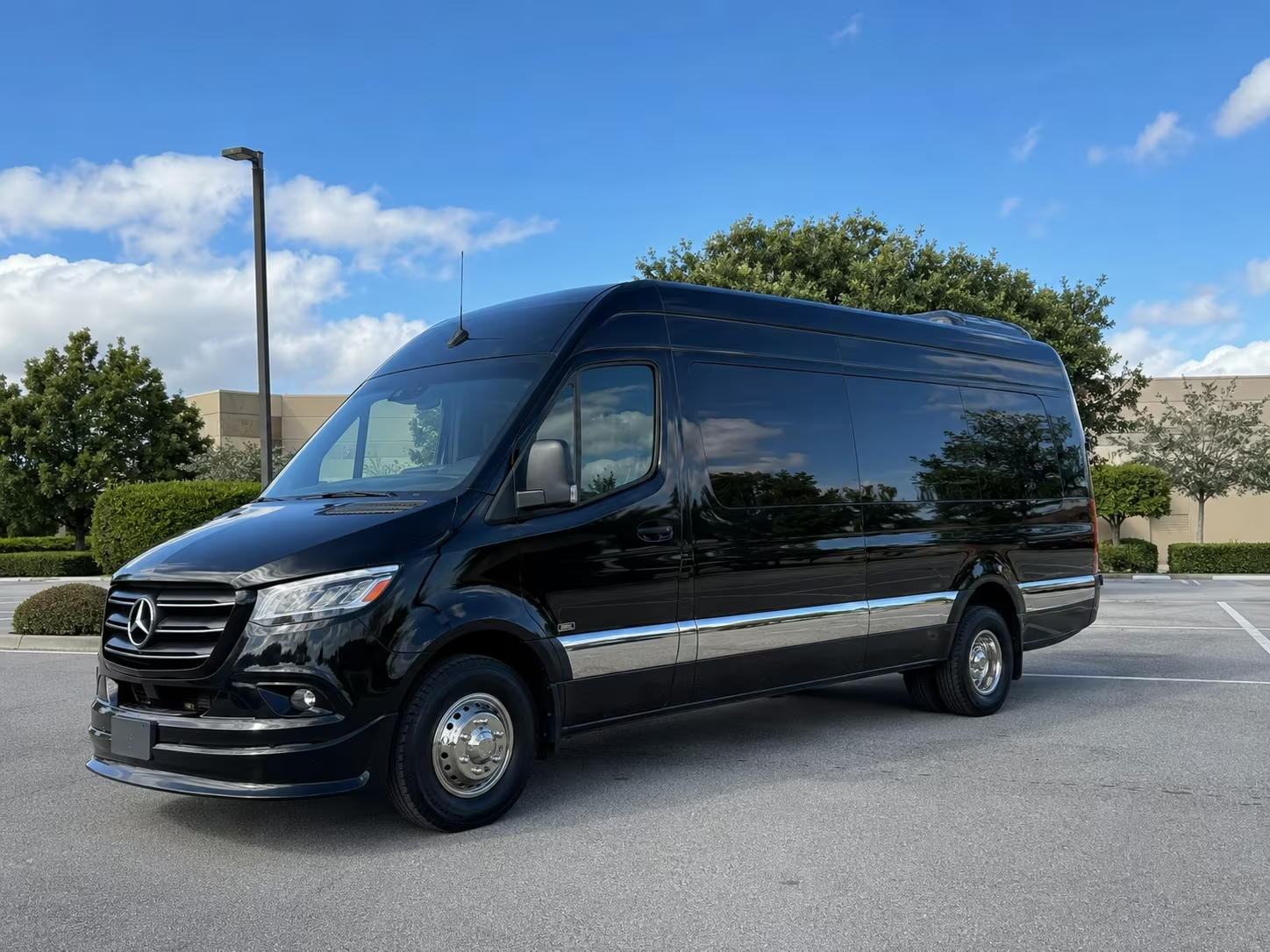
| Sprinter Van | Up to 14 | Rear cargo area for bags | Small executive groups, families under 14 | Flexible curb access at any terminal, easy to maneuver the departures level |
| 14-Passenger Sprinter Limo | Up to 14 | Modest overhead and rear | VIP departures, smaller groups in style | Premium leather, USB charging, compact enough for the International Terminal Level 3 curb |
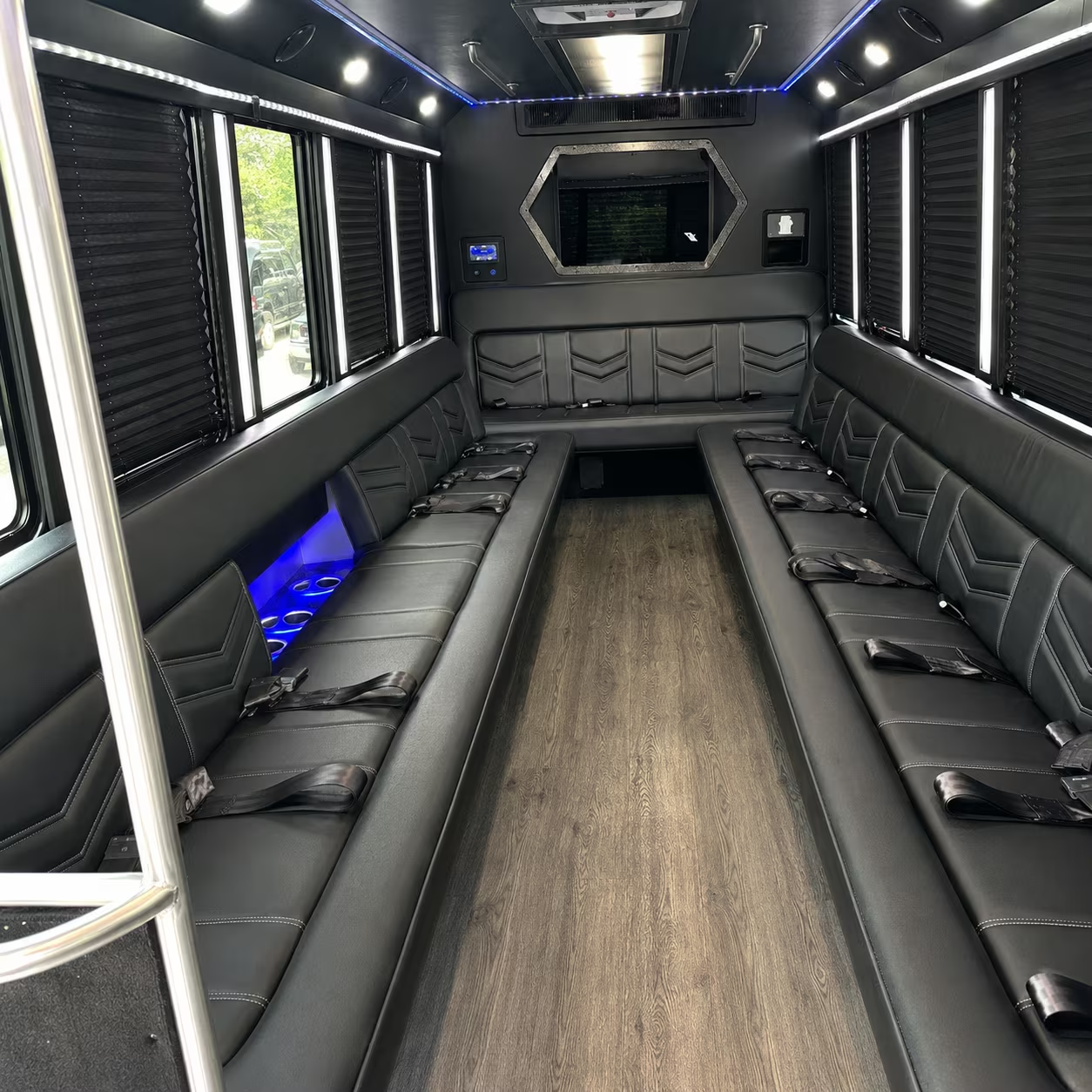
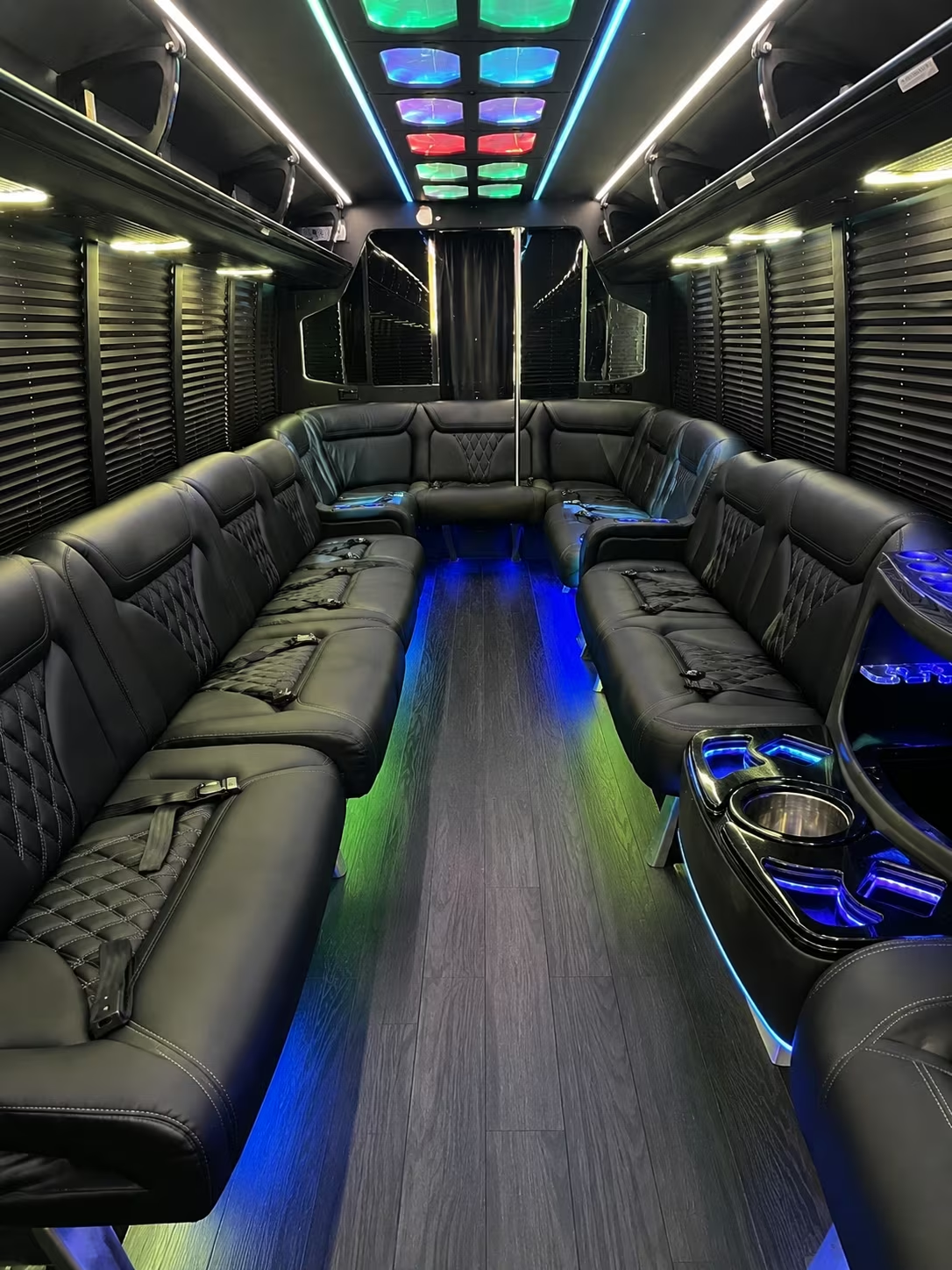
| 15–35 Passenger Minibus | 15–35 | Overhead bins plus some underfloor | Mid-size groups, corporate shuttles, domestic trips with carry-ons | Reclining seats, powerful A/C; maneuverable enough to navigate the T2 and T3 construction approach |
| 40–56 Passenger Charter Bus | Up to 56 | Deep undercarriage bays for full-size suitcases | Large groups with international luggage; multi-day trips where everyone checks bags | Undercarriage bays absorb full-size luggage for 40+ travelers; onboard restroom for early-morning runs before the Bay Bridge |
The undercarriage luggage bays on a full-size charter bus make a real difference on international departures. A group of 40 flying to Europe for two weeks will have 40 large suitcases — which a minibus simply cannot absorb. A 56-passenger charter bus typically has bay storage sufficient for a full-size bag per person and then some, meaning the group loads in one clean pass at the departures curb and the bus clears the zone without a second trip.
The onboard restroom is a genuine benefit on 5:30 a.m. Oakland pickups, when people need a bathroom before the bridge regardless of how early they woke up. For groups of 15 to 30 with lighter luggage — the corporate team flying carry-on, the family reunion on a domestic hop — a minibus hits the right balance of cost and comfort.
Oakland to SFO Charter Bus and Party Bus Rental Prices
Oakland-to-SFO transfers typically price by the hour, and most runs fall in the 2 to 3 hour window — that covers the drive, the curbside drop, and any buffer on either end. To give you an idea of planning ranges from the network: a 15 to 35 passenger minibus runs approximately $200 to $250 per hour on weekdays and $200 to $275 per hour on weekends. A 40 to 56 passenger charter bus runs approximately $200 to $350 per hour, with per-day rates from roughly $1,350 to $2,850 for full-day arrangements.
Those are planning ranges — your actual quote depends on the vehicle, the date, your specific Oakland pickup address, and how many hours the bus is reserved. Call 341-239-1430 or use the online form to get pricing for your specific trip in under a minute. There's no account required and no obligation to book.
Per person, the math often surprises people. A 40-person group on a 2 to 3 hour charter bus run comes to roughly $600 to $1,000 total — about $15 to $25 per person each way — with the whole group coordinated, everyone delivered to the same terminal curb, and zero parking on either end. For groups where some people had been considering BART to SFO (roughly $10 to $13 per person for the 48-minute ride, with no help for luggage and no group coordination built in), the charter bus is close on per-person cost and dramatically better on the logistics front for groups over 15.
See the Oakland party bus prices page for a fuller breakdown of rate ranges by vehicle type.
For round-trip airport runs — dropping a group for a departure and picking them up on return — the pricing depends on whether the bus holds during the trip or returns to Oakland and makes a second run. Both arrangements are available through the network; just describe your full itinerary when you request the quote so the estimate covers the whole picture.
SFO Parking vs. a Charter Bus from Oakland: The Per-Car Math
The straightforward case for an Oakland charter bus or party bus rental to SFO is arithmetic. On-site SFO garages run approximately $25 to $39 per day depending on the specific garage and whether you pre-book — the Domestic and International garages sit at the higher end, while the Long-Term Garage (connected to all terminals by the free AirTrain Red Line) offers a lower daily cap. For a 7-day international trip, one car in on-site parking costs roughly $175 to $273 before gas and the Bay Bridge toll.
For groups, those numbers multiply without mercy. A family of 12 in two cars, flying SFO for a 10-day Europe trip: two parking spots at roughly $30-plus per day for 10 days comes to $600 or more in airport parking alone — before gas, before the $8.50 Bay Bridge toll each way per car, and before the coordination overhead of two vehicles leaving from separate addresses and meeting at the same terminal at the same time. A minibus from Oakland handles the whole group for a fraction of that number, split across 12 people, with nothing left to deal with when the group gets back.
That's the calculation that makes the charter bus obvious once someone actually runs the numbers.
Frequently Asked Questions About Oakland Charter Bus and Minibus Rentals to SFO
Where exactly does a charter bus drop off at SFO?
Charter buses and minibuses drop off on the departures level at each terminal's curbside white zones: Level 2 for domestic terminals (T1, T2, and T3) and Level 3 for the International Terminal. These are active-loading zones — the bus pulls up, the group unloads, and the vehicle keeps moving. There is no staging or extended waiting at the curb.
Terminal 3's departure curb between Doors 6 and 13 is closed through 2027; United D/E gate passengers are redirected to Terminal 2 during construction.
Which SFO terminal does my charter bus target for drop-off?
It depends on which airline your group is flying. The bus targets the specific terminal for your carrier: Harvey Milk T1 for Alaska, Delta, JetBlue, or Southwest; T2 for American, Air Canada, or United passengers departing from D or E gates (during construction); T3 for United F-gate passengers; and the International Terminal Level 3 for any international flight. If your group is split across different airlines, confirm each person's terminal in advance — the bus can stage a two-terminal drop-off if needed.
Is the Bay Bridge or San Mateo Bridge faster from Oakland to SFO?
Bay Bridge (I-80 West to US-101 South to I-380 West) is shorter — about 24 to 26 miles from downtown Oakland — and faster off-peak at 35 to 50 minutes. The San Mateo Bridge route (I-880 South to CA-92 West to US-101 North to I-380 West) adds 10 or more miles but can avoid Bay Bridge gridlock during peak hours. For groups departing from south Oakland or the Coliseum area, the San Mateo Bridge is often the practical call since it avoids backtracking north.
From downtown, Uptown, or North Oakland, the Bay Bridge is generally faster unless traffic is already severe at departure time.
How early should an Oakland group leave for an international flight at SFO?
SFO recommends arriving 3 hours before international departures. Add the Oakland-to-SFO drive time — 35 to 50 minutes off-peak, 55 to 80 minutes during weekday rush — plus 15 to 20 minutes of group boarding time on the Oakland side. For a 10:00 a.m. international flight, the bus should typically depart Oakland around 6:00 to 6:30 a.m.
For peak-hour flight slots or Friday departures, build more cushion. Being 30 minutes early at SFO costs nothing; being 20 minutes late costs the flight.
Is there a drop-off difference between SFO's domestic and international terminals?
Yes, and it matters. Domestic terminals drop off on Level 2; the International Terminal has ticketing and check-in on Level 3 (the main hall), with arrivals on Level 2 and AirTrain on Level 4. The Level 3 approach is a physically separate curb from the domestic Level 2 curbs.
If part of your group is on an international flight and part on a domestic connection, confirm both terminal addresses before the bus departs Oakland so the drop-off sequence is already planned.
Can the bus wait at SFO for a delayed international arrival?
SFO's arrivals curb operates on the same active-loading rule as departures — no extended parking or idling. For pickups during the 2026 runway closure period (through approximately October 2), when roughly 25 percent of arriving flights are delayed 30 minutes or more, the standard approach is for one person in the arriving group to send a confirmation once the group has bags and is assembled at the arrivals exit. Until then, the bus stays in motion or holds in a nearby staging area.
Build a 30 to 45 minute buffer into any SFO arrival pickup through October 2026.
How much does a charter bus or minibus from Oakland to SFO cost?
Oakland-to-SFO runs are typically 2 to 3 hours. A minibus (15 to 35 passengers) runs roughly $200 to $250 per hour on weekdays; a full charter bus (40 to 56 passengers) runs approximately $200 to $350 per hour. Your actual quote moves with vehicle, date, and pickup location — call 341-239-1430 or use the online form for pricing in under a minute.
Per person on a 40-seat bus over a 2-hour run, the all-in cost typically lands in the $15 to $25 range, which competes directly with BART fares and includes coordinated luggage handling and a single curbside drop at the right terminal.
Should I worry about SFO's runway construction affecting my group's departure?
Runway 1R is closed from March 30 through approximately October 2, 2026, and the impact falls primarily on arriving flights — the combined runway closure and FAA approach restriction reduced SFO's hourly arrival capacity significantly, causing delays on about 25 percent of inbound flights. Departure times are less directly affected, though delays can cascade if your aircraft is arriving late. For departing groups: download your airline's app for real-time alerts, stick to the recommended 3-hour international pre-arrival window, and do not cut the Oakland-to-SFO drive close.
For pickup runs on arriving flights, the 30 to 45 minute delay buffer is the key adjustment through October.
Can BART handle a large Oakland group heading to SFO?
BART runs direct from 19th Street Oakland to SFO in approximately 48 minutes for about $10 to $13 per person. It's a strong option for solo travelers or pairs flying light. But for 20 people heading to the International Terminal with two checked bags each, BART means coordinating 20 separate boarding times, managing full-size suitcases on platform stairs, and hoping everyone makes the same train.
A charter bus from Oakland loads the whole group at one address, handles the bridge, and delivers everyone to the right departures curb — no individual ticketing, no luggage scramble, no per-person coordination overhead. For groups over 15 with checked luggage, the bus wins on convenience even when the per-person price is similar. The Oakland International Airport shuttle guide covers the OAK-side transit picture separately, if part of your group is flying domestically out of OAK instead.
What happens if my group is split between the International Terminal and a domestic terminal?
It's more common than people expect — a group that booked through one airline has international passengers going to the International Terminal (Level 3) and domestic connection passengers going to T1 or T2. A charter bus or large minibus can do a staged drop-off: International Terminal first at Level 3, then a domestic terminal at Level 2. Confirm the terminal split when you request the quote so the pickup and drop-off sequence is built into the estimate from the start.
There is no need to book two separate vehicles for a split-terminal group.
Book Your Oakland-to-SFO Charter Bus or Minibus Today
The Oakland-to-SFO run comes with real decisions — Bay Bridge or San Mateo Bridge, Level 2 or Level 3, T2 or T3 during construction — and those decisions are a lot easier to make when the entire group is on one vehicle with one plan. Oaklandpartybuscompany.com connects you to a large network of bus companies serving Oakland with a range of vehicles from Sprinter vans up to 56-seat motorcoaches, and you can compare options and get a quote in under 60 seconds with no account required and no obligation to book.
Call 341-239-1430 any time to talk through your group size, Oakland pickup address, and flight time — or use the online form right now for instant availability. The bus shows up at your door, crosses the Bay, and drops your group at the right departures curb. You show up.
The rest is handled.